
Endurance racing is experiencing its greatest renaissance in decades. With automotive giants like Ferrari, Porsche, Toyota, and Cadillac pouring millions into the World Endurance Championship (WEC) and IMSA, the top tier of sportscar racing is more competitive than ever. But beneath the carbon fiber bodywork, this battle isn’t just about winning the 24 Hours of Le Mans—it is a high-speed R&D laboratory for tomorrow’s performance road cars.
To understand what makes this era so unique, we must decipher the technical regulations dividing the grid. Le Mans Hypercar (LMH) and Le Mans Daytona h (LMDh). While they race wheel-to-wheel under a unified Balance of Performance (BoP), their engineering philosophies are radically different.
Understanding the WEC Divide: LMH vs. LMDh
The FIA and ACO introduced these two overlapping rule sets to encourage manufacturer participation. How? By offering different levels of developmental freedom and cost.
The LMH (Le Mans Hypercar) rulebook is the purist’s route. Manufacturers like Ferrari (with the 499P), Toyota, and Peugeot build their cars entirely from scratch. They design their own bespoke chassis, their own internal combustion engines, and their own custom hybrid systems. Crucially, LMH cars typically deploy their electric power to the front axle, making them all-wheel-drive under acceleration.
The LMDh (Le Mans Daytona h) formula, utilized by Porsche, Cadillac, and BMW, is a cost-capped alternative. These teams must purchase a base chassis from one of four approved suppliers (Dallara, Multimatic, Ligier, or Oreca). They also use a spec hybrid system mandated by the series (featuring Bosch and Williams Advanced Engineering components) which delivers power exclusively to the rear axle. Manufacturers only develop the internal combustion engine and the aerodynamic styling.
The Hybrid Architecture: MGU Placement Matters
For the engineers in the paddock, the difference between front-axle (LMH) and rear-axle (LMDh) hybrid deployment drastically changes tire degradation and vehicle dynamics.
An LMH car can pull itself out of slow corners using the front electric Motor Generator Unit (MGU), reducing the slip angle and preserving the rear slick tires over a double stint. To keep the racing fair, the governing body implements a strict Balance of Performance (BoP). BoP establish a minimum speed (often around 190 km/h) before the LMH cars are legally allowed to activate their front electric motors.

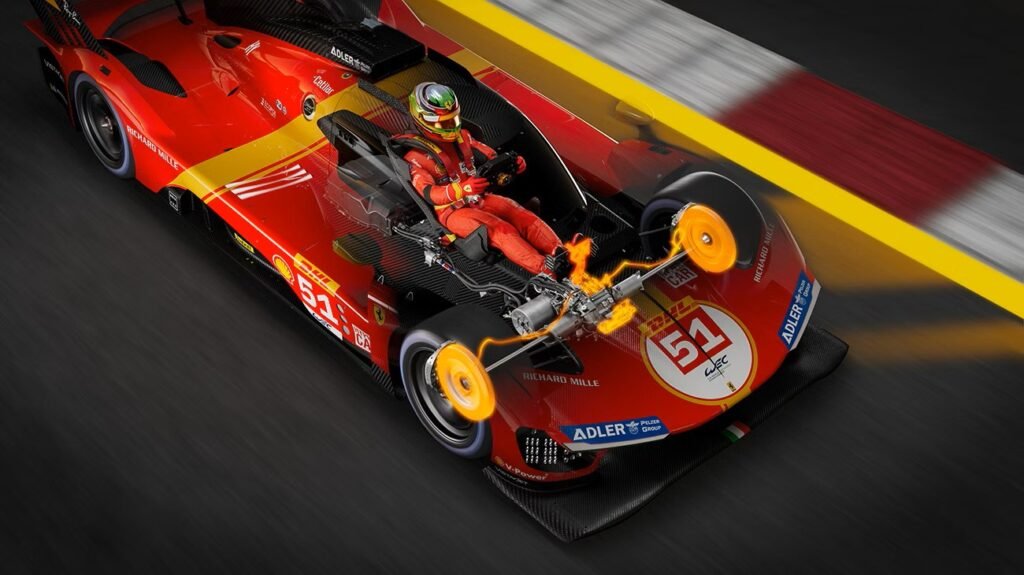
The Ferrari 499P Hybrid system placement (copyright Ferrari)
Race to Road: The True Purpose of the Hypercar Era
Why are manufacturers so invested in these complex MGU deployment rules? Because the technology translates directly to the showroom floor.
The thermal efficiency required to make a WEC Hypercar finish a 24-hour race on a limited fuel allocation is directly accelerating the development of consumer hybrid systems. The bespoke battery management software used by Ferrari’s 499P to harvest kinetic energy under braking is laying the groundwork for the next generation of plug-in hybrid supercars. Meanwhile, Porsche’s integration of a spec hybrid unit with a twin-turbo V8 in the 963 is teaching the brand how to seamlessly blend electric torque with internal combustion for their future sports sedans.

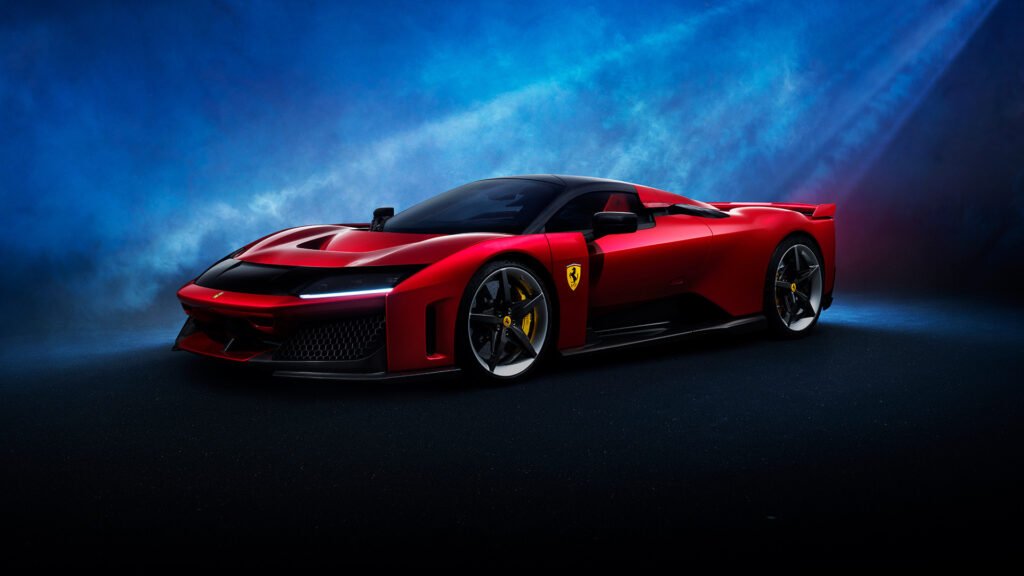
A Ferrari F80 (copyright Ferrari)
The golden era of endurance racing isn’t just delivering incredible track battles. It is actively writing the engineering blueprint for the performance vehicles you will be driving in the next decade.